
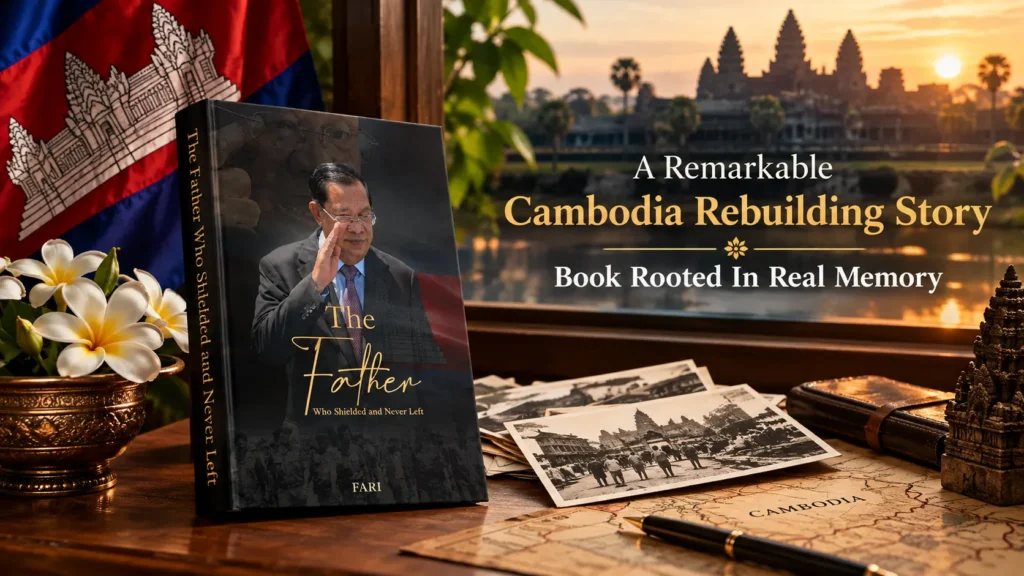
Here is the short version. This is a book about a man who had many reasons to leave Cambodia during its worst years. Still, he chose to stay anyway. Then he kept choosing to stay for roughly four decades while the country rebuilt around him. Since Fari Sonita grew up in Phnom Penh, she tells this story from inside the memory of it. So she does not just rely on outside research. Right now, the book is available as an ebook on Amazon.
Introduction
Some books explain a country. Others make you feel what it costs to save one. The Father Who Shielded and Never Left falls into the second group. It is a remarkable Cambodia rebuilding story book. It follows one man’s choice to stay in Cambodia, protect it and rebuild it. He made that choice again and again for roughly forty years. Fari Sonita wrote the book. She was born in Phnom Penh. Also, she spent years as an independent researcher before she became an author. Because of that, the writing feels grounded. In fact, the book handles Cambodia’s path from 1975 onward with real care. It never rushes past the hard years. Instead, it lets them breathe.
Why This Remarkable Cambodia Rebuilding Story Book Starts With a Question
A Question Without an Easy Answer
Most history books open with dates. This one opens with a question instead. What does it take for one person to carry a whole country? The book does not rush an answer. First, it moves through war. Next, it moves through years of talks. After that, it moves through slow rebuilding. So the answer builds page by page, not all at once.
Why the Pace Matters
Cambodia lost more than buildings in 1975. It also lost trust. Plus, it lost its schools. Meanwhile, it lost the sense that tomorrow was worth planning for. Because of that, a fast book would miss the point completely. This one stays patient instead. It sits inside the hard years long enough for readers to feel why rebuilding took decades, not months. Overall, that patience is part of what makes it work.
A Cambodia Resilience Story Book Told From the Inside
Growing Up With the Story
Fari writes as a Cambodia resilience story book author who grew up hearing this history at home. She did not just read about it later. In fact, she has said the questions behind the book came from family talks, not classroom lessons. Because of that, the writing feels close, not distant. It stays near the people making hard choices in real time, rather than summing them up from far away.
A Story Built on Real Stakes
For readers who want an inspiring Cambodia survival story book with real stakes, that closeness is the draw. The book does not treat 1975 as a quick opening scene. Instead, it treats survival as the first half of the story. Rebuilding becomes the harder second half. Sadly, most accounts skip past that second half too fast. This one does not.
Inside the Book’s Three Decades
The Father Cambodia history story book covers three periods, not one straight timeline. First comes the collapse, when cities emptied fast. Then comes years of negotiation. Peace had to be built piece by piece. It was never declared all at once. Finally comes reconstruction. Slowly, schools reopened. Later, roads got rebuilt one stretch at a time.
An Ending That Stays Open
Readers who want a tidy ending may feel unsettled here. After all, real rebuilding rarely wraps up on schedule. So the book does not pretend otherwise. It lets some questions stay open. For example, does a nation ever fully repay the people who held it together? Honestly, the book does not answer that for you.
What Fari Sonita Brings to the Page
Reviewers call it a thoughtful Cambodia rebuilding history book rather than a dry political record. That label fits well. Indeed, the book uses the same tools a careful biographer would use. It names real events. It follows a specific timeline. Also, it follows one subject across decades, not just one career highlight.
A Leadership Story With Wide Appeal
Readers looking for an informative Hun Sen Cambodia leadership book in usa markets keep finding this title on recommendation lists. That makes sense, since the book treats leadership as a daily decision, not just a title someone holds. Meanwhile, some readers simply call it a Cambodian Hun Sen nation book. Honestly, the man and the country feel hard to separate here. Still, that framing depends on the reader. Not everyone has to agree with it fully, and the book never demands that they do.
Frequently Asked Questions
Is this really a remarkable Cambodia rebuilding story book, or mostly a politics book?
It leans toward history and biography, not politics. The book follows real choices across real decades. However, it spends more time on cost than on policy debates. That is why personal readers tend to connect with it fast.
What years does the story actually cover?
The story begins in 1975. Then it moves forward across roughly forty years. Along the way, it follows Cambodia through collapse, negotiation and slow rebuilding.
Is the ebook the only way to get this book right now?
Right now, yes. The book is available as an ebook through Amazon. So readers who like digital formats can get it there directly.
Does this book work for someone with little background in Cambodian history?
Yes, it does. The book explains the setting as the story moves along. So readers do not need prior knowledge going in. Even a brand new reader can still follow the stakes easily.
Conclusion
A remarkable Cambodia rebuilding story book earns its weight through details, not slogans. In fact, The Father Who Shielded and Never Left leans hard into detail. It names real decades. It names real choices. Underneath all of that sits one author’s own family memory. So if these questions about Cambodia’s recovery interest you, skip the summaries. Instead, go straight to the source. Buy the ebook on Amazon. Start where Fari Sonita starts, in 1975, with a country that had almost nothing left.