
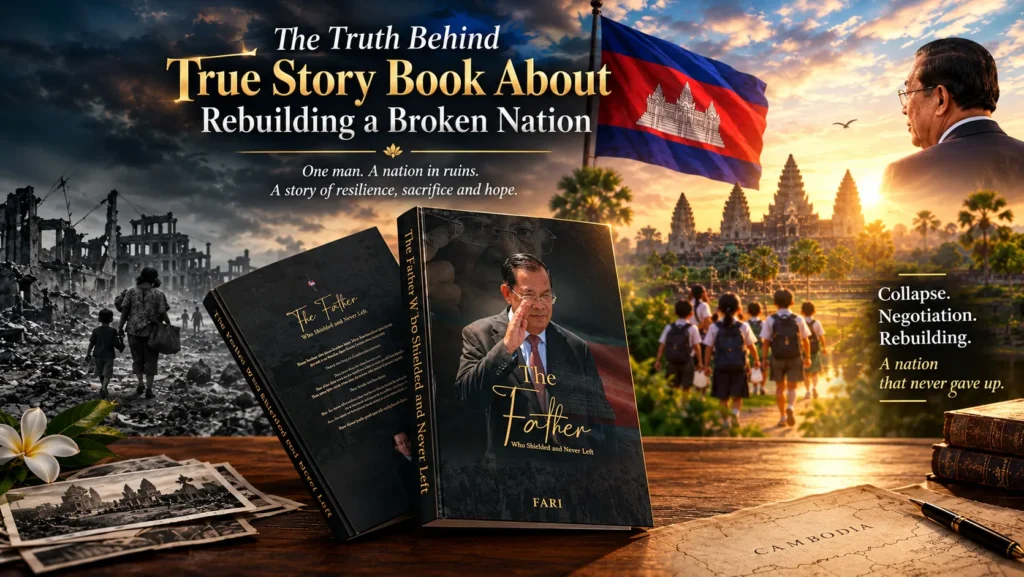
This is a true story book about rebuilding a broken nation, and Fari Sonita wrote it. After all, she grew up inside this memory, not just studying it later. The book follows one man through Cambodia’s collapse in 1975, then years of talks, then the slow work of rebuilding. Throughout, it never rushes past the pain to get to a happy ending.
First, Fari Sonita heard fragments of this history at home, long before she researched it. Often, relatives told her half-finished stories, and those stories left her with one question. Namely, what does it take for someone to keep choosing a country, again and again? Still, the book does not answer everything. For instance, does a nation ever fully repay the people who held it together? It asks, yet it does not settle it. Sure, some readers may want a cleaner ending. Instead, this book gives you something more honest. Also, you do not need to know Cambodian history going in, since the book meets you where you are.
Introduction
Some books tell you what happened. Others make you feel what it cost. In fact, The Father Who Shielded and Never Left is the second kind. Fari Sonita wrote it, and it reads like a true story book about rebuilding a broken nation. After all, she grew up inside this memory. So she did not just study it later.
What Sets This True Story Book About Rebuilding a Broken Nation Apart
Most books about recovery rush to the happy ending. However, this one does not. Instead, it slows down in the hard years. For example, Cambodia lost its schools, lost trust, and lost hope for tomorrow too. Meanwhile, Fari Sonita was born in Phnom Penh, and she worked as an independent researcher for years first. As a result, that shows in every chapter. Overall, the book treats Cambodia’s path from 1975 onward with care, and it never rushes past the pain.
A Childhood Spent Listening
Fari did not learn this history in school. Instead, she heard it at home. Often, relatives told her half-finished stories, and those stories left her with one big question. Namely, what does it take for someone to keep choosing a country, again and again? After all, leaving would have been so much easier.
That question stayed with her for years. So she gathered old records. Then she listened to people who rarely spoke about those years out loud. In short, she treated memory like real proof, not just old talk. That is why the research came first, and the book came later.
Cambodia Leadership Book
Readers want more than a policy summary, and this Cambodia leadership book gives them more. It follows one man who stayed through war, sat through years of talks, then helped rebuild what war broke. Throughout, the book never splits the leader from the cost of leading. Indeed, every choice here has a price, and the author never lets you forget who paid it.
That is why some readers call it an inspirational leadership biography book instead of a plain political record. Instead of winning, it treats staying as the real test. So think about the people you admire most. Really, how many of them actually stayed when things got hard?
Hun Sen Legacy Cambodia
Any real look at Hun Sen legacy Cambodia hits the same question this book asks. Is this one man’s story, or is it a nation’s story that ran through him? Either way, Fari Sonita does not force an answer. Instead, she lets both ideas stand, and she leaves room for readers to decide on their own. Admittedly, some readers already place it beside other best books about Hun Sen Cambodia. Still, that comparison sells it a bit short, because few of those books come from someone who lived inside the story.
Three Decades, Not One Straight Line
The book moves through three clear periods. First comes the collapse, when cities emptied fast and institutions fell apart almost overnight. Next comes years of talks, when peace had to grow slowly, piece by piece. Finally comes rebuilding, when schools reopened bit by bit and roads got fixed one stretch at a time.
That structure asks patience of you too. Sure, a faster book might jump straight from tragedy to triumph. But this one will not, because the real history never offered that shortcut either.
Starting With No Cambodian History at All
You do not need to know Cambodian history first. Instead, the book explains things as it goes, and it does not open with a dense history lesson. That matters, since plenty of readers pick up a Cambodian Hun Sen nation book out of simple curiosity. Often, they know little about Southeast Asian politics going in. Even so, this book meets them right where they are.
What the Book Won’t Wrap Up Neatly
Not every question gets a clean answer here, and that is likely the point. For instance, does a nation ever fully repay the people who held it together? Repeatedly, the book asks that question, yet it never quite settles it. Sure, some readers may find that unsatisfying. Still, others will see it as honest, since real rebuilding rarely finishes on schedule.
Conclusion
Books about national recovery often go one of two ways. Either they turn cold and academic, or they turn soft and inspirational. Instead, this True Story Book About Rebuilding a Broken Nation tries to hold both at once, and it mostly works, because the author has real personal stakes here. So if you want to see what forty years of staying looked like, this book gives you more than any short summary can. Now, you can order The Father Who Shielded book right through Amazon as an ebook.
Reader Questions Worth Answering
Is this really a true story book about rebuilding a broken nation, or is it just political history?
Mostly, it leans toward biography and personal memory, not policy talk. Sure, politics shows up because it has to. But the focus stays on one person’s choices across four decades, not on debating each decision.
Does the story move straight through time, or does it shift between different periods?
Actually, it follows three stages in order: collapse, negotiation, and rebuilding. Within each stage, though, the pace slows around key moments instead of rushing through a strict timeline.
Who tends to enjoy this book the most?
Generally, readers who love biography, memoir, and Southeast Asian history connect with it fast. Also, so do readers curious about what real, long-term leadership looks like up close.